Computer vision application
FaceFACS 3D Studio
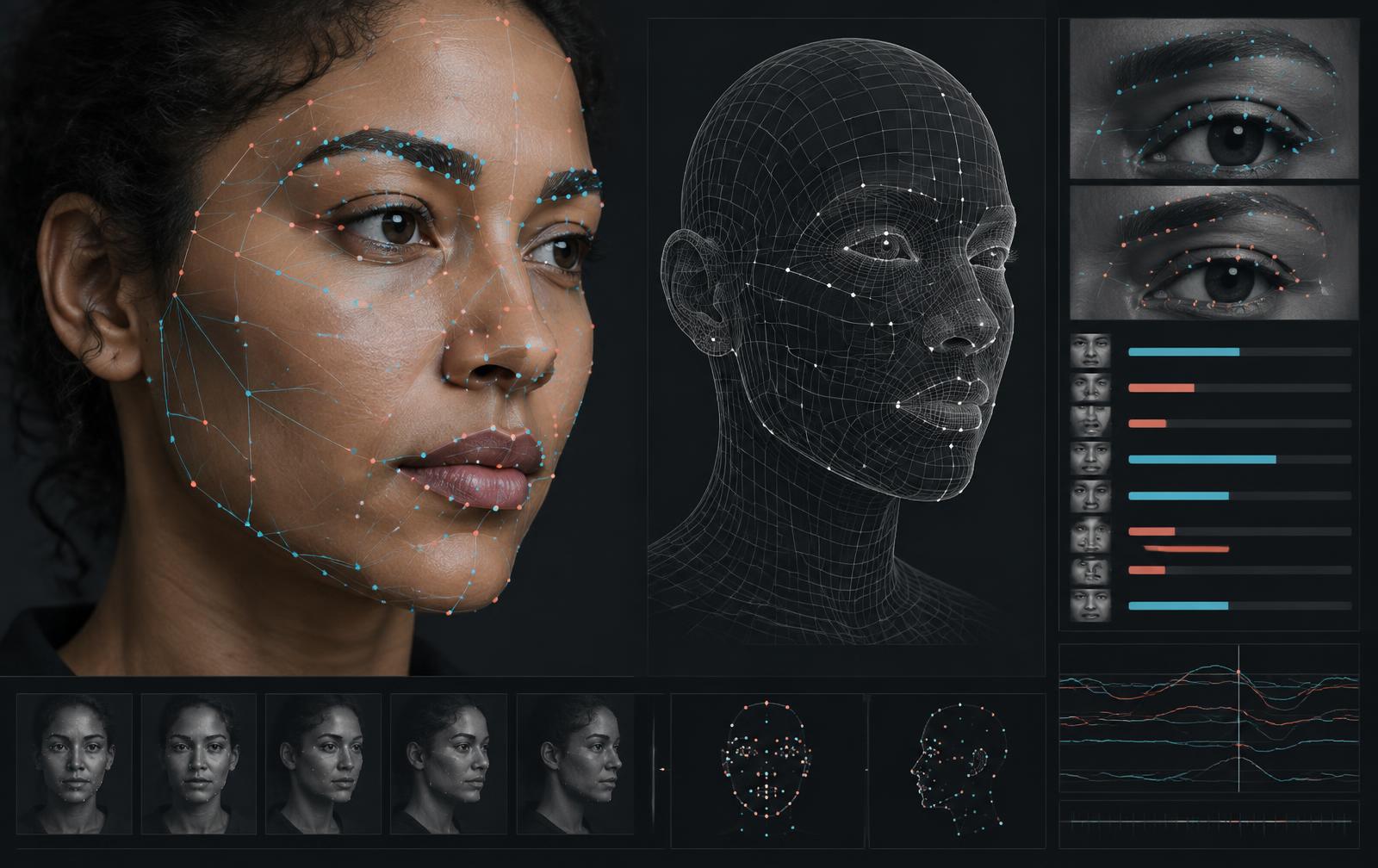
A Windows-first vision studio that turns live webcam frames into dense facial landmarks, an interactive 3D face and interpretable facial action-unit estimates.
- Platform
- Windows desktop
- Stack
- Python, OpenCV, MediaPipe
- Input
- Live HD webcam
01
Real-time pipeline
Webcam frames pass through automatic upright-orientation calibration before MediaPipe Face Landmarker returns dense 3D landmarks and 52 blendshape coefficients. The application smooths those signals, estimates selected action units and presents the camera overlay beside an interactive 3D renderer.
02
Core capabilities
Face tracking
Live contours, face bounds and clear tracking status over the camera feed.
3D exploration
Keyboard-controlled pitch, yaw, roll, zoom, mesh and landmark views.
Orientation
Automatic testing across four rotations with manual calibration controls.
Action units
Smoothed estimates for 16 familiar facial action units from blendshape signals.
03
Engineering choices
The project uses the current MediaPipe Tasks API, configurable camera resolution and index, a verified model download, low-buffer capture and timestamp-safe video inference. One-click Windows setup scripts, focused unit tests and actionable camera or dependency errors make the prototype easier to run reliably.
04
Responsible scope
Blendshape-derived action units are presented as engineering estimates, not certified FACS coding. The application is intended for computer vision, animation, interaction, research prototyping and learning; it is explicitly not designed for diagnosis, lie detection or high-stakes psychological inference.